[ TEASER I RADICAL HOPE – Eye to Eye ]
PERFORMANCE I Radical hope – Eye To Eye, 2022
Live performance, Duration 70’
Our bodies are the prism through which we experience our existence.
By Sarah Theurer and Malene Hagen, 2023
Radical Hope is not only radical in the sense of extreme but also in the original sense of radix, root – a growing hope. Stef Van Looveren’s performance creates fertile ground for this hope by staging a sex-positive community of diverse bodies. “Within society we are all somehow in drag” says Van Looveren. “We live in a time where there is a lot of focus on the physical,” the multidisciplinary artist* explains of their interest in self-stylisation. “A body has to tell us who you are or how you identify yourself. But I think a body is just a tool.” Van Looveren is referring to artists like Orlan, who in her video performance The Reincarnation of Saint Orlan (1990-1993) adapted her face through various surgical operations to the art-historical beauty ideals of Venus, Diana, Europa, Psyche and Mona Lisa. Her metamorphosis, staged as a media event for the camera, painfully turned the (female) body-per into an instrument. In “Glitch Feminism” (2020), Legacy Russel writes: “We use ‘body’ to give material form to an idea without form, an abstract compilation. The concept of ‘body’ is situated in social, political and cultural discourses that change depending on where the body is situated and how it is interpreted. When we gender a body, we make assumptions about its function, its socio-political condition, its immutability.” This is precisely where Van Looveren’s work comes in.
Radical Hope – Eye to Eye is a symphony for six bodies and various objects. Together they become sculptural assemblages. It is their first ever performance and is based on the video work of the same name Radical Hope (2018) in which van Looveren, together with 30 performers, immerse themself in various emotional states such as desire, bliss, sadness or rage. Inner emotions are expressed here through physical mutations. Shot in a clinically white room with a 360° camera, the bodies seem to exist in a kind of virtual reality. Van Looveren lets the camera rotate around itself in slow motion, whereby the field of vision of the camera, which is considerably larger than that of the human eye, repeatedly distorts the depicted bodies in an unnatural way. Their movements are alienated and appear inhuman. Captured by the machine eye and seemingly exactly reproduced, the images provoke associations with a scientific taxonomy. The bodies, each subverting gender binaries in their own way, seem to float: Van Looveren compares them to plasma, a mixture of free electrons, positive ions and neutral particles of a gas that move in different energy or excitation states through constant interaction with each other.
Em/Disbodiment – disembodied embodiment
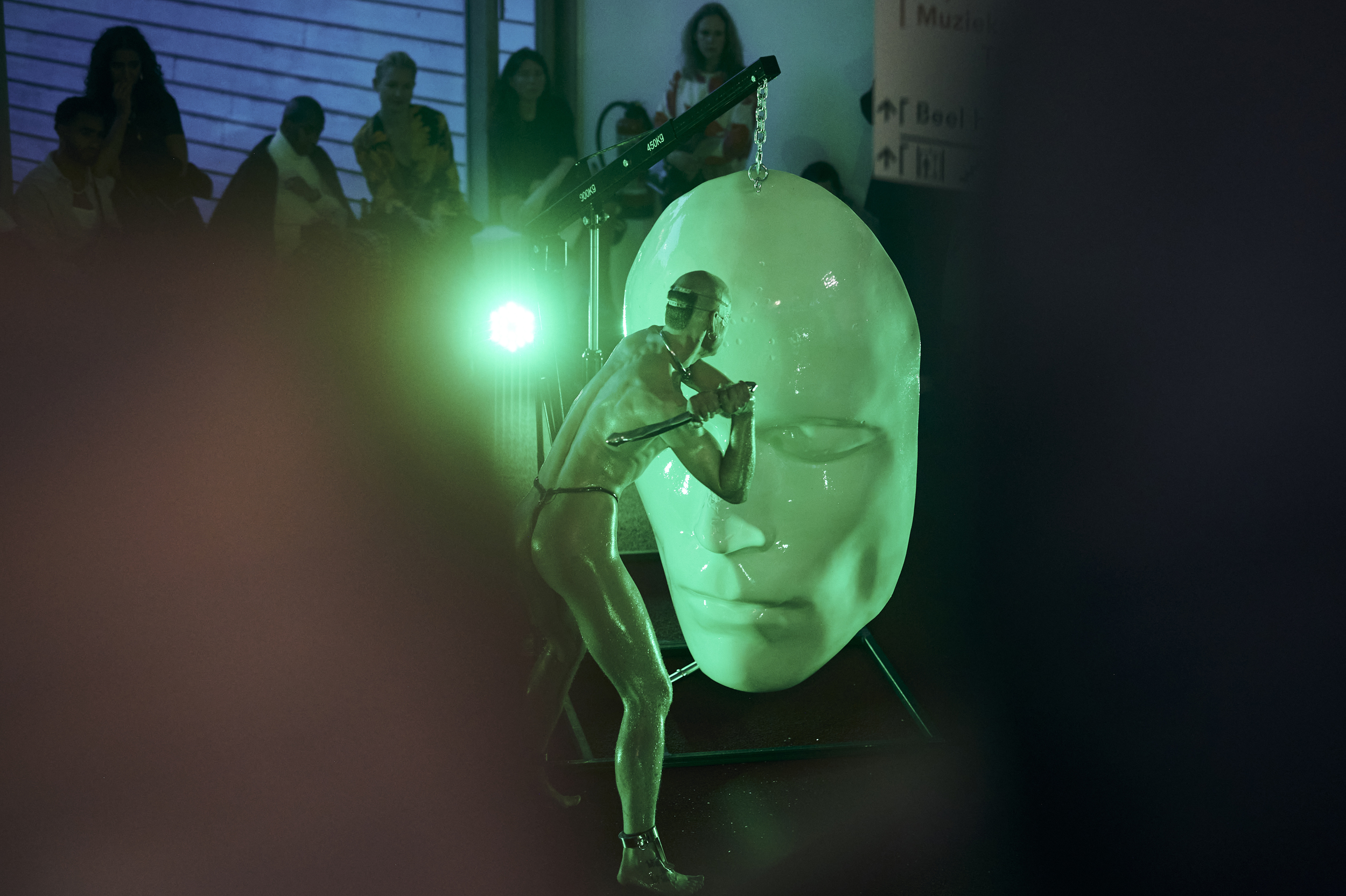
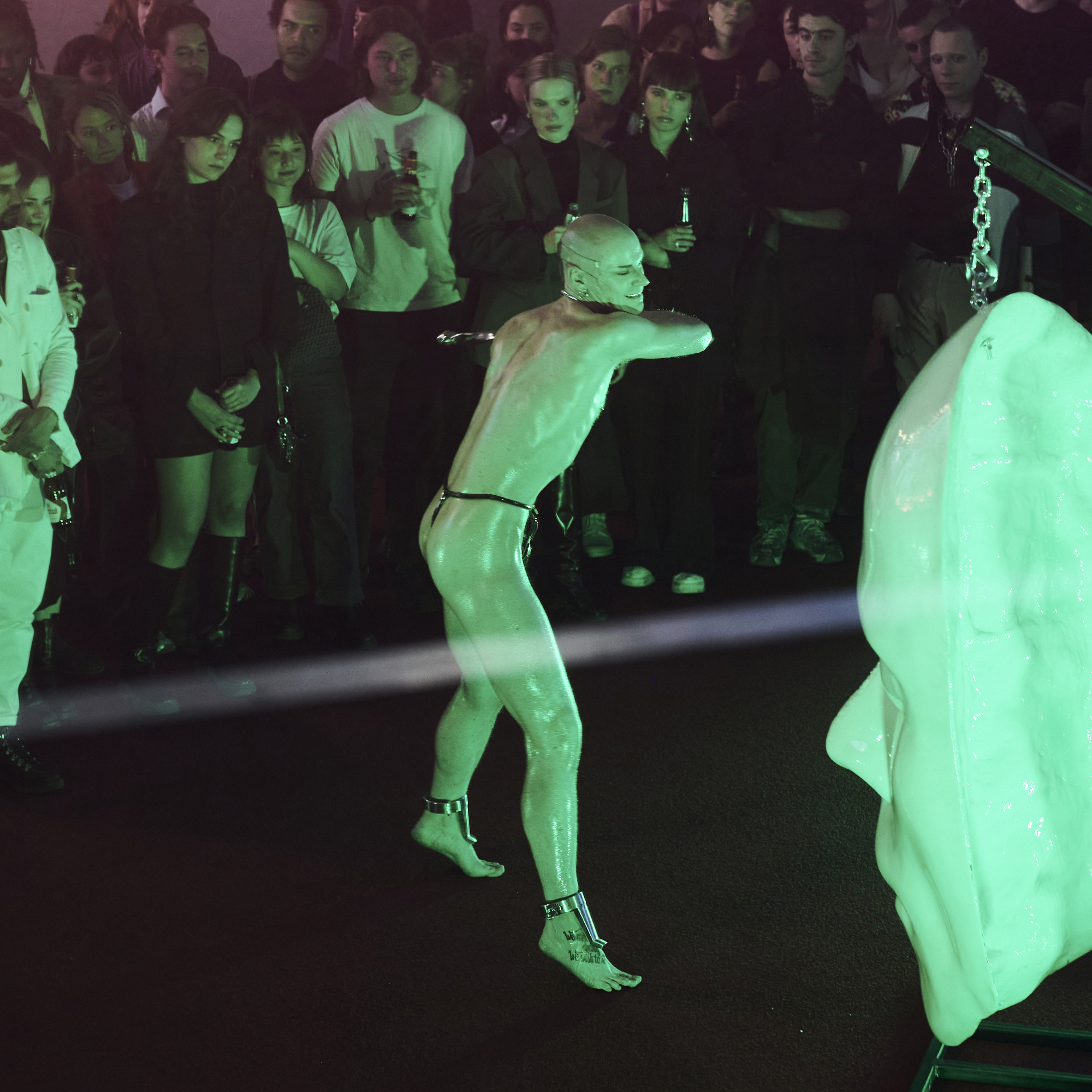
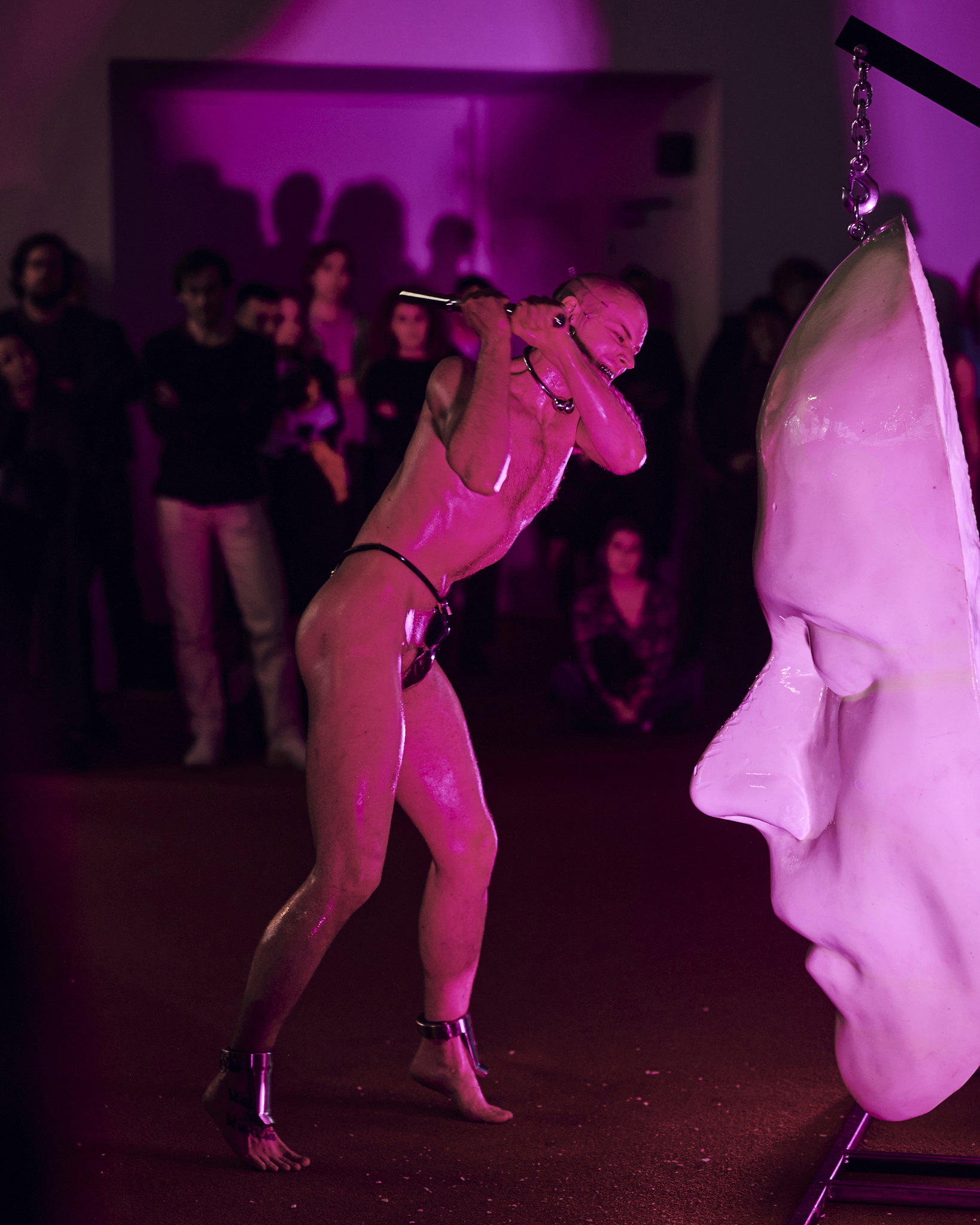
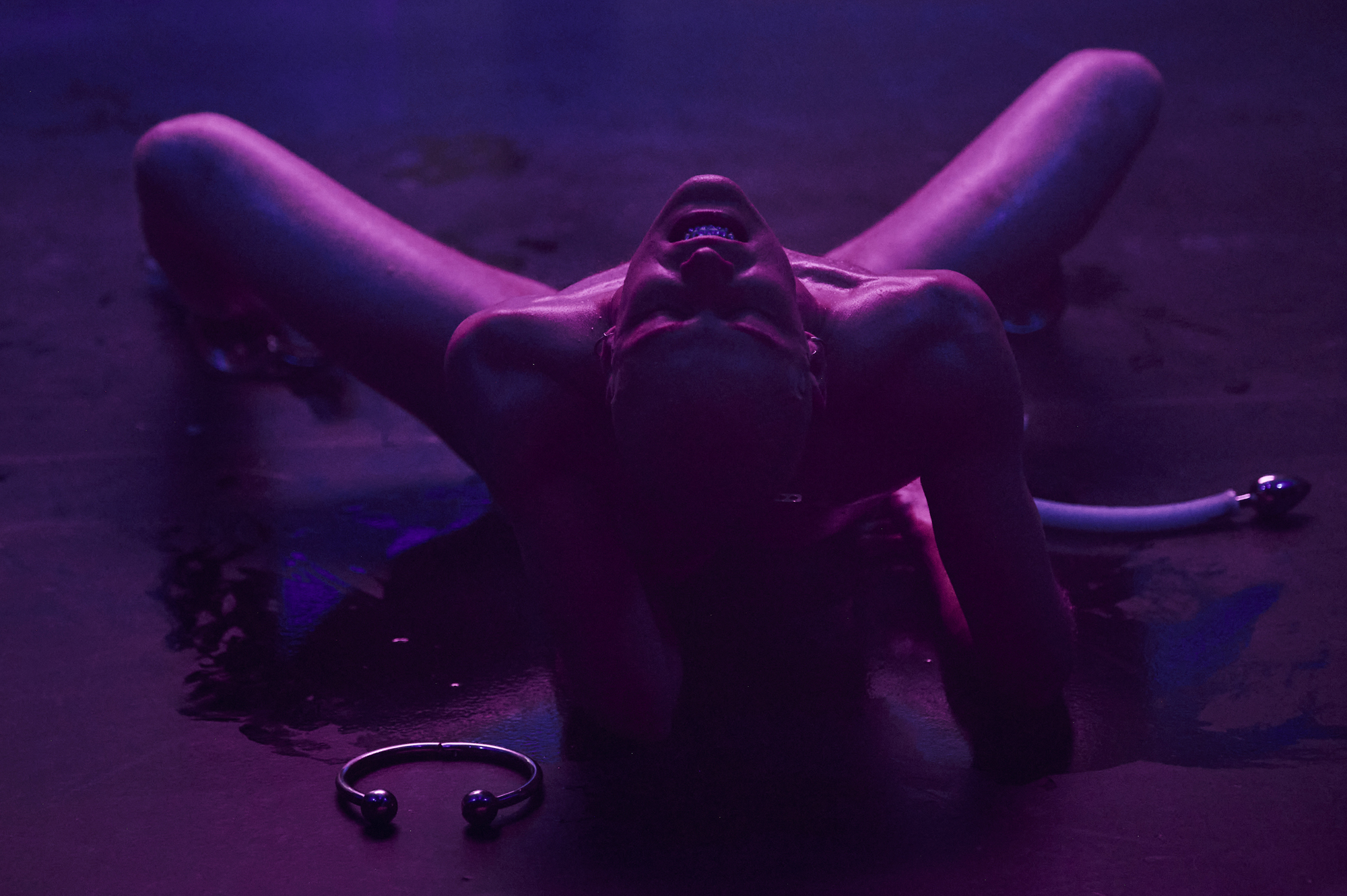
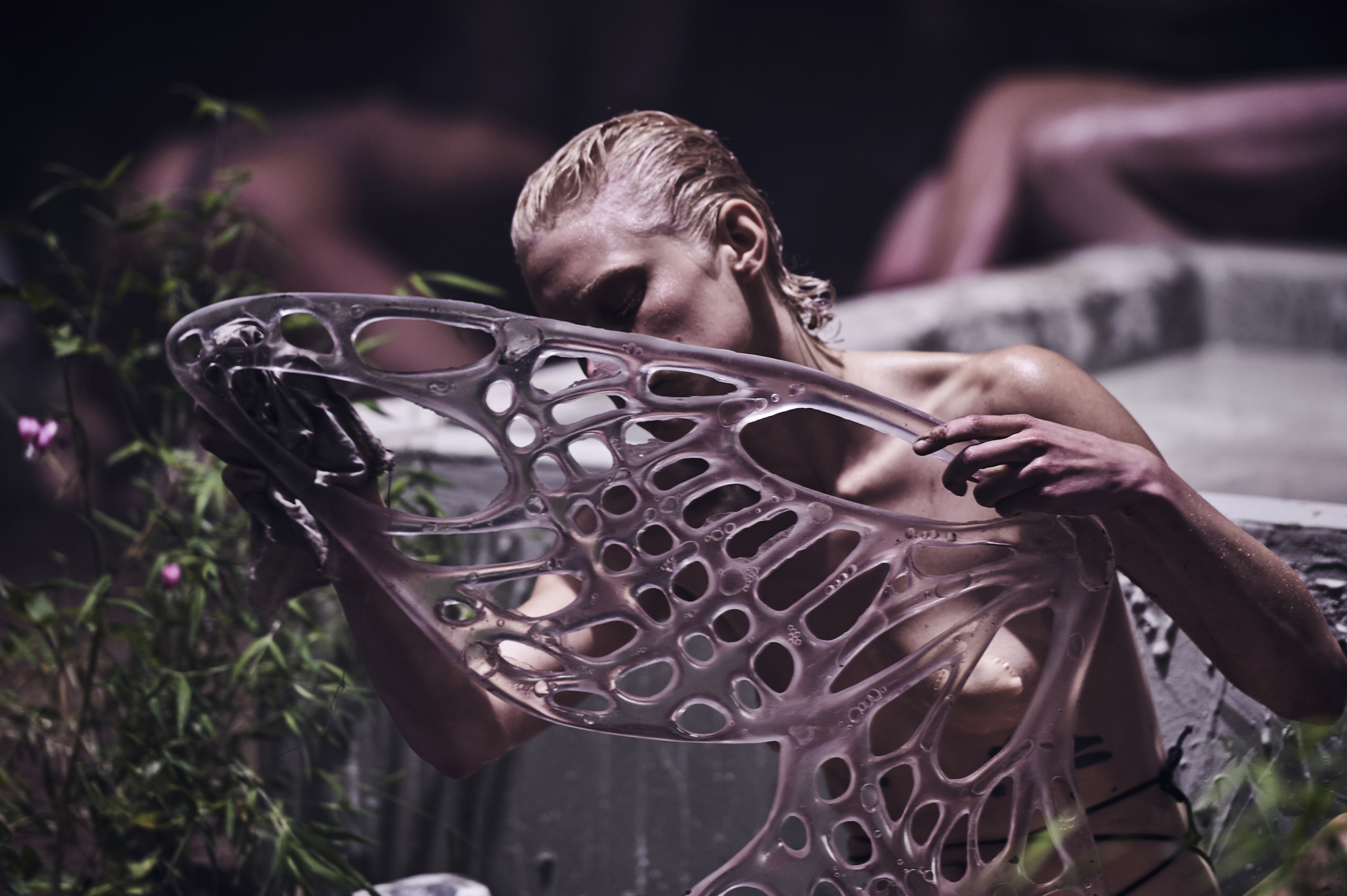
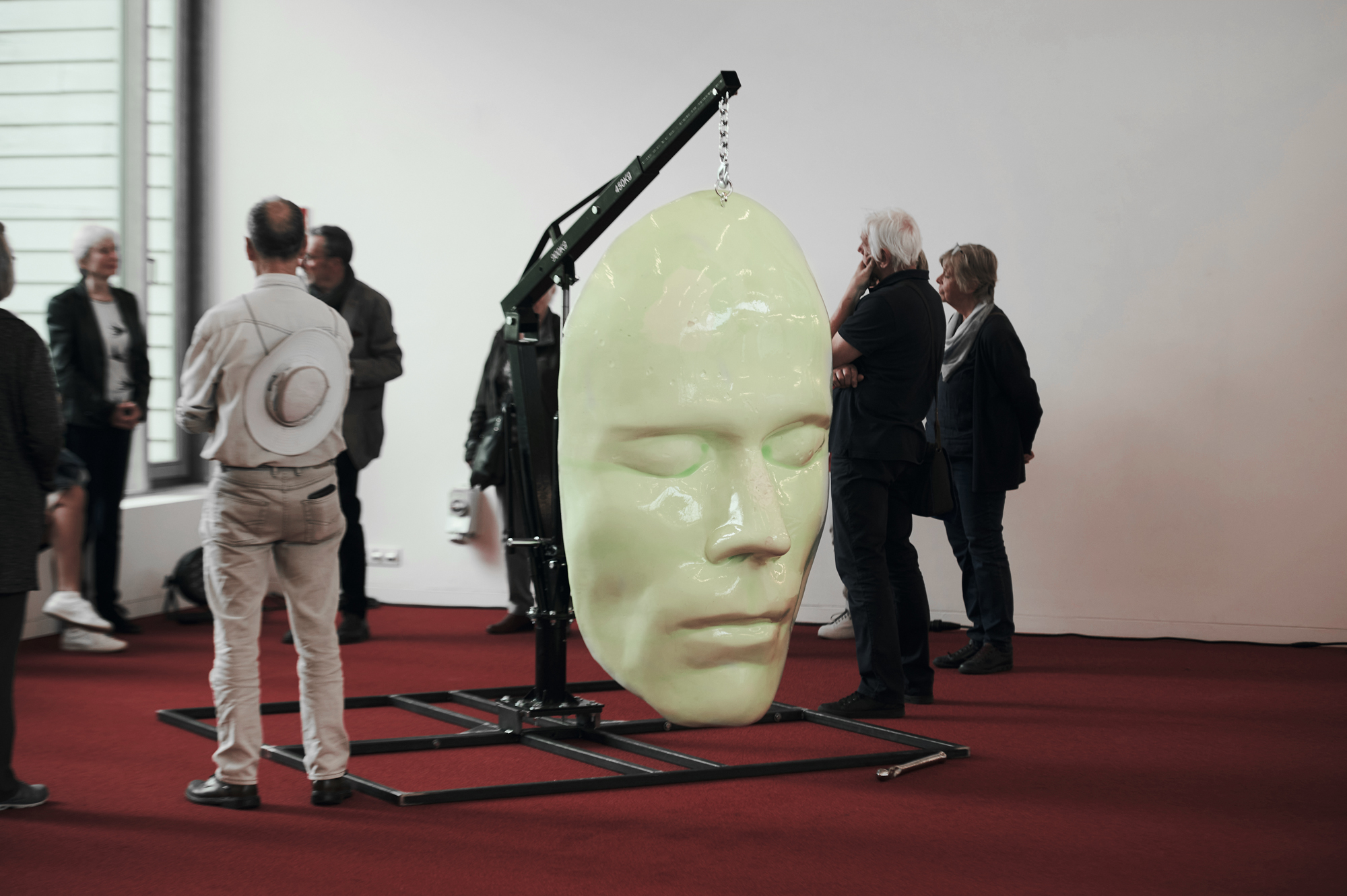
Van Looveren shows their videos often on curved walls, they think it fits the gender-bending nothing should stay “straight”. while the bodies in the video appear at a safe distance and through the camera, we meet them directly in the performance – eye to eye; face to face. The performance is heralded by the hollow sound and the notch lent by a blunt metal body on polished synthetic resin. Again and again, Van Looveren strikes a larger-than-life mask of their likeness. Their skin gleams delicately from the sweat of violent confrontation with their own form. Metal clamps that force the feet to dance deform Van Looveren’s body just as painfully-pleasurably as they demolish their mask. “We are all stuck in our bodies, that is, stuck in a grid of contradictory ideas about what those bodies mean, what they are capable of, and what they may or may not do,” writes Olivia Laing in Everybody (2021). Our bodies dramatically expose us to a range of privileges and prejudices. The rhetoric of White Supremacy, misogyny and LGBTQIAP+ discrimination keeps imposing on our bodies the idea that some kinds of bodies should be more right, more important, more valuable than others.
Flaming / Bleeding hearts
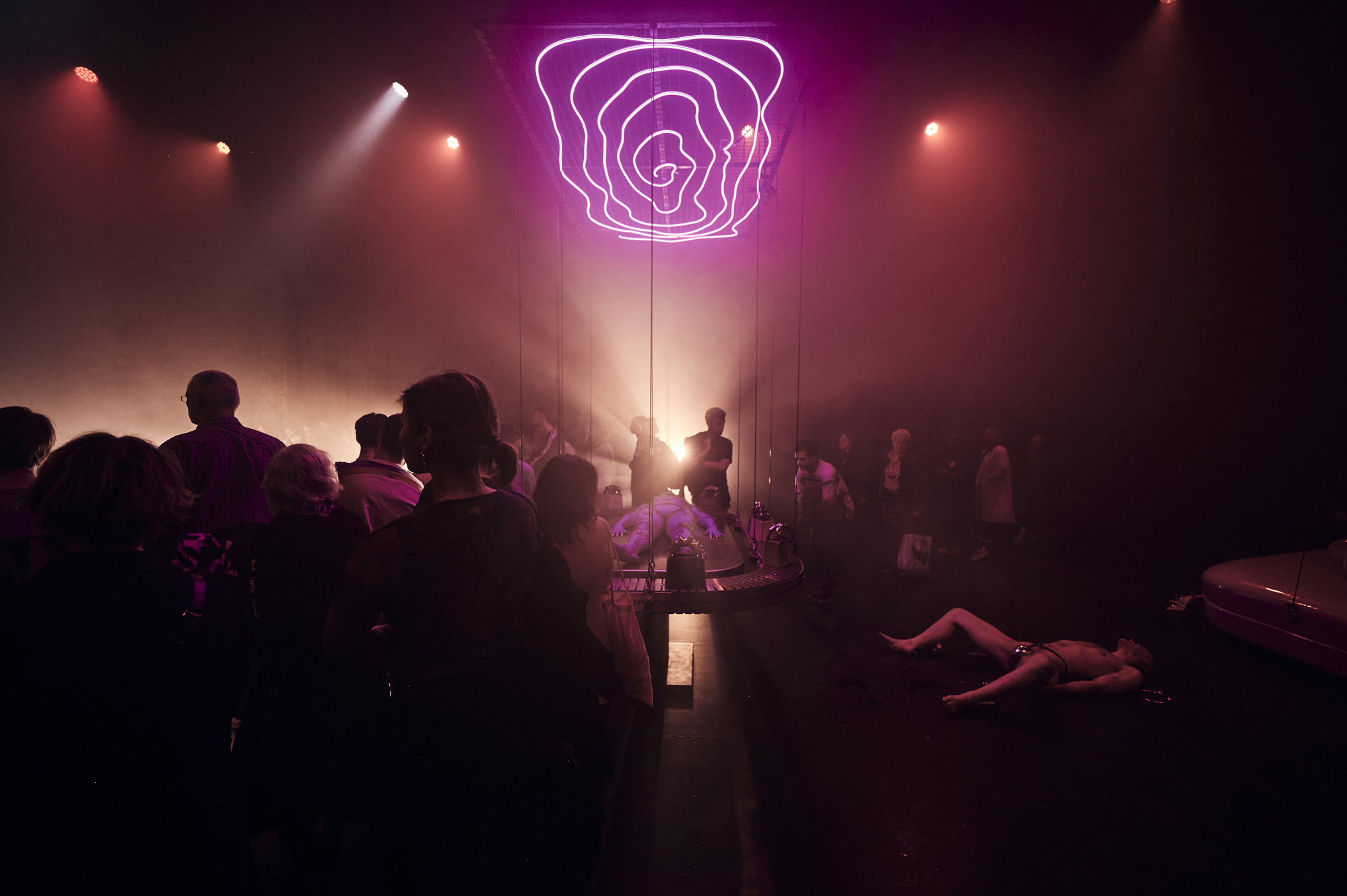
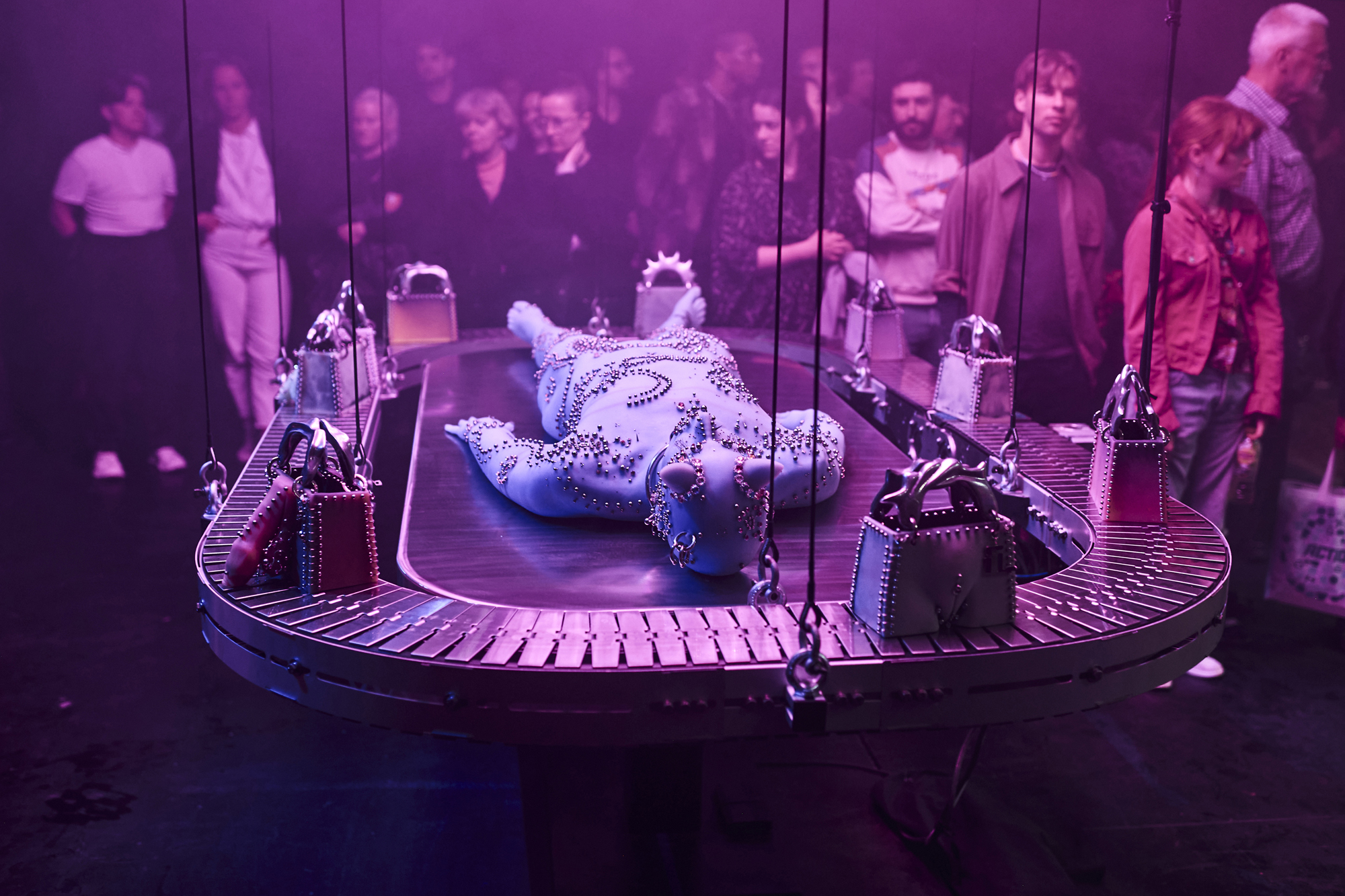
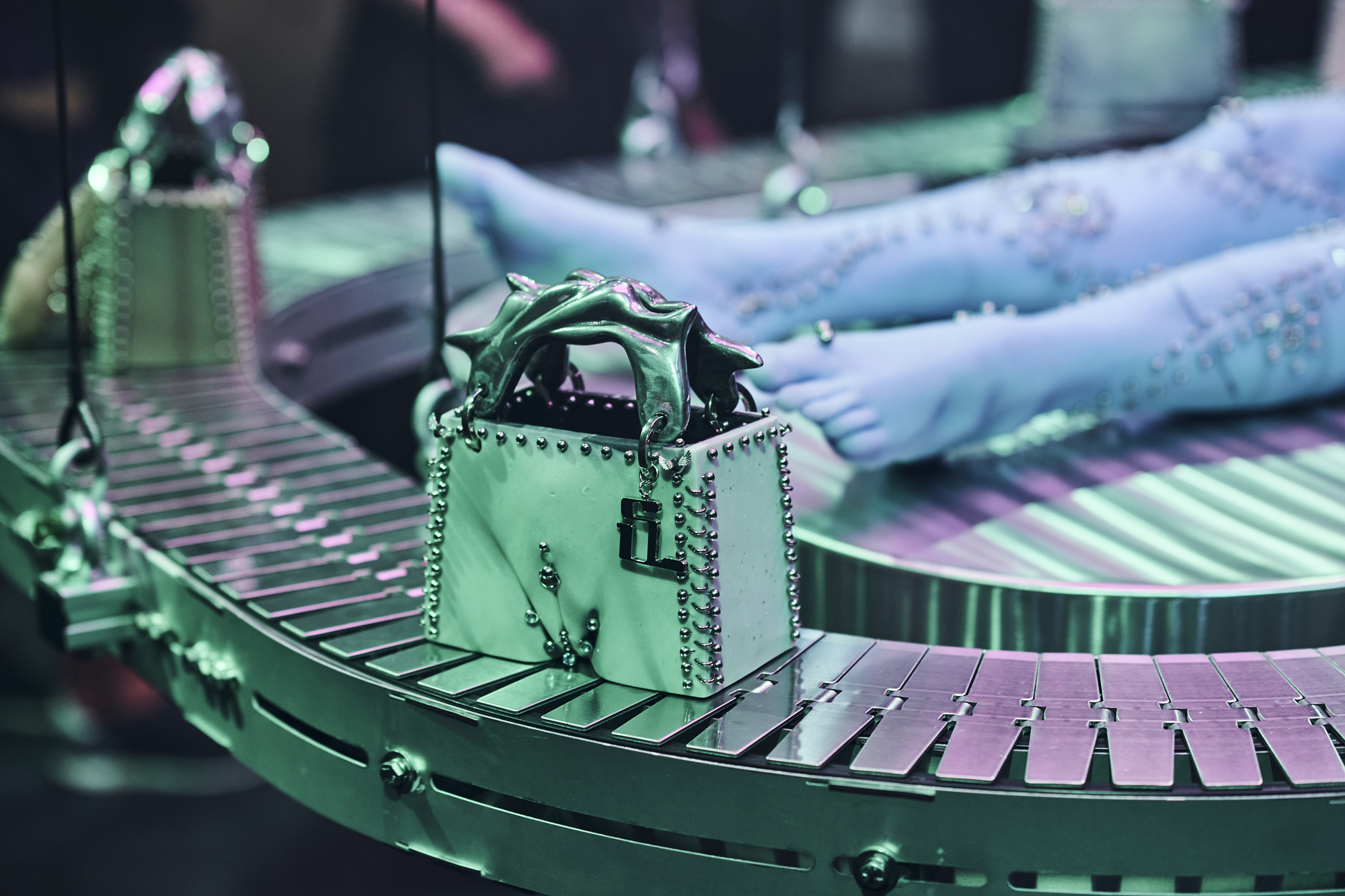
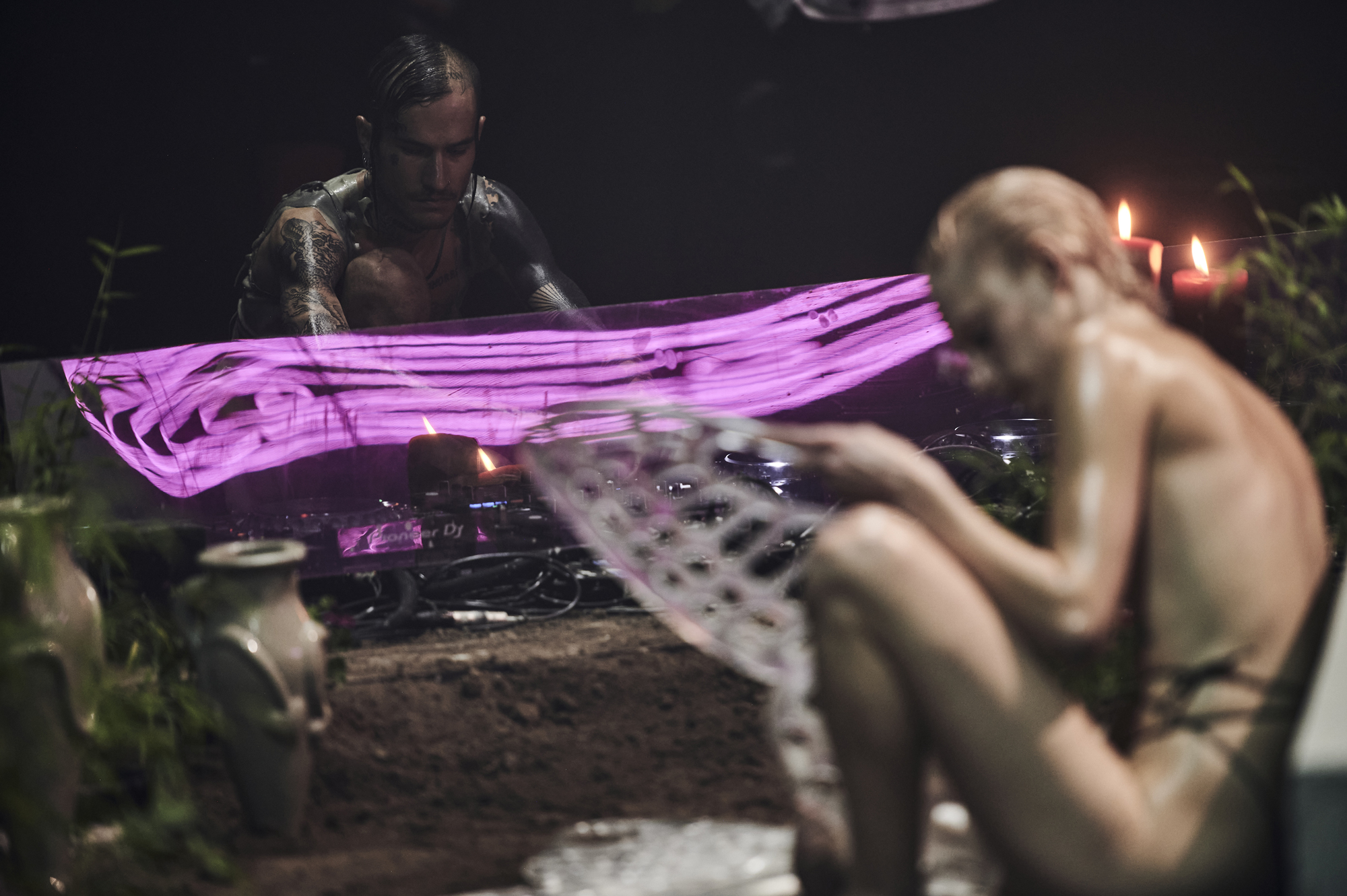
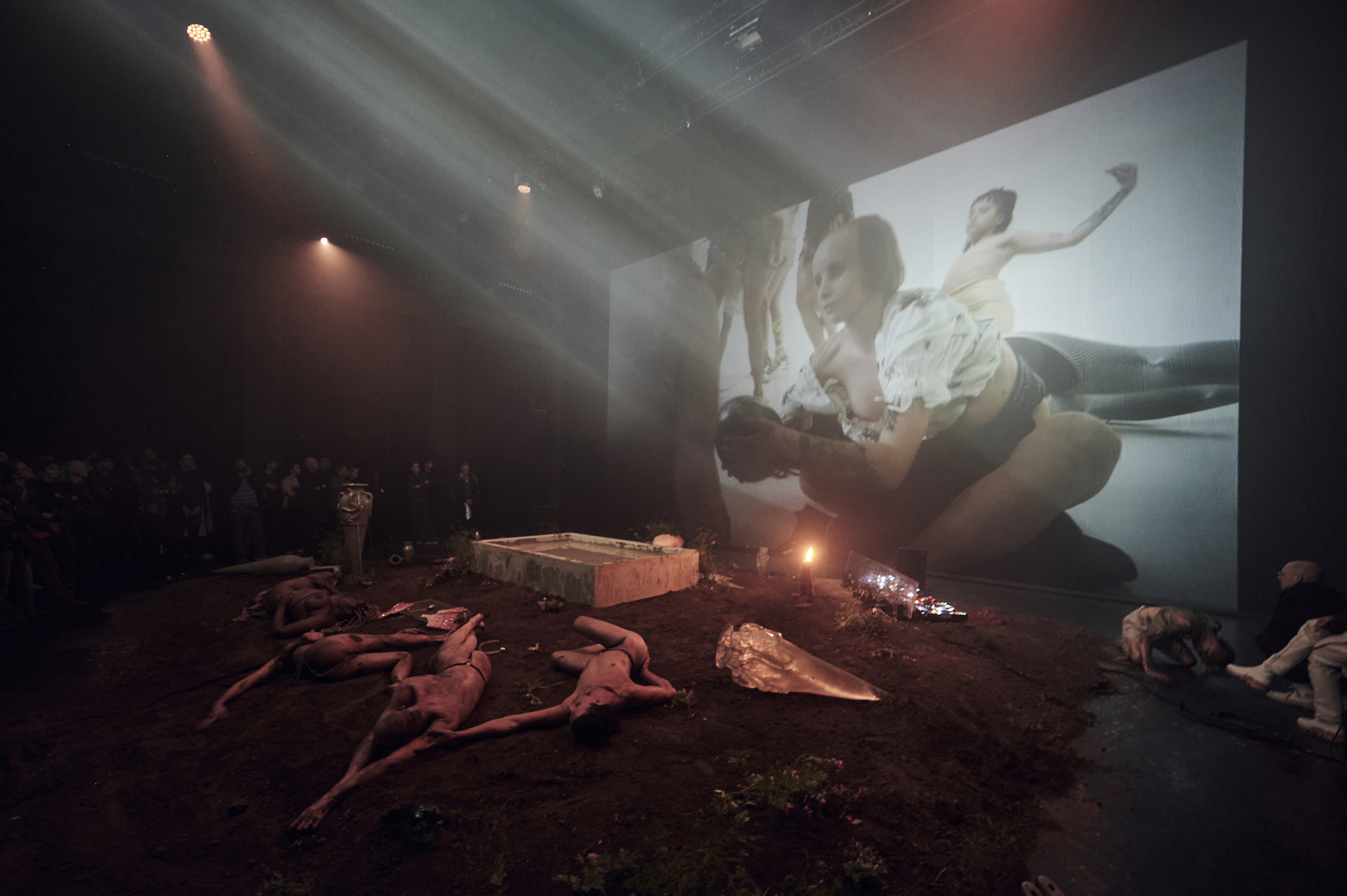
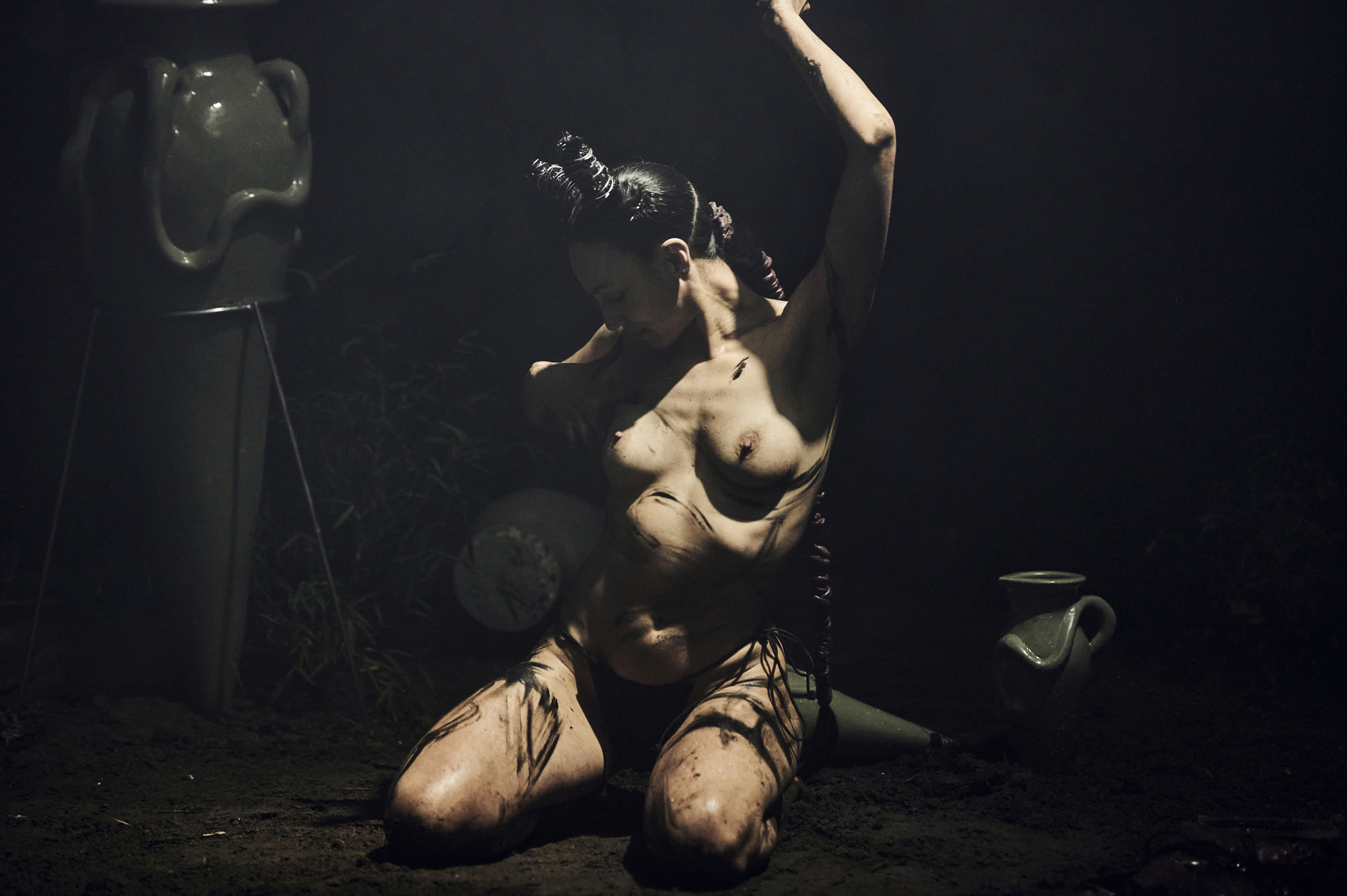
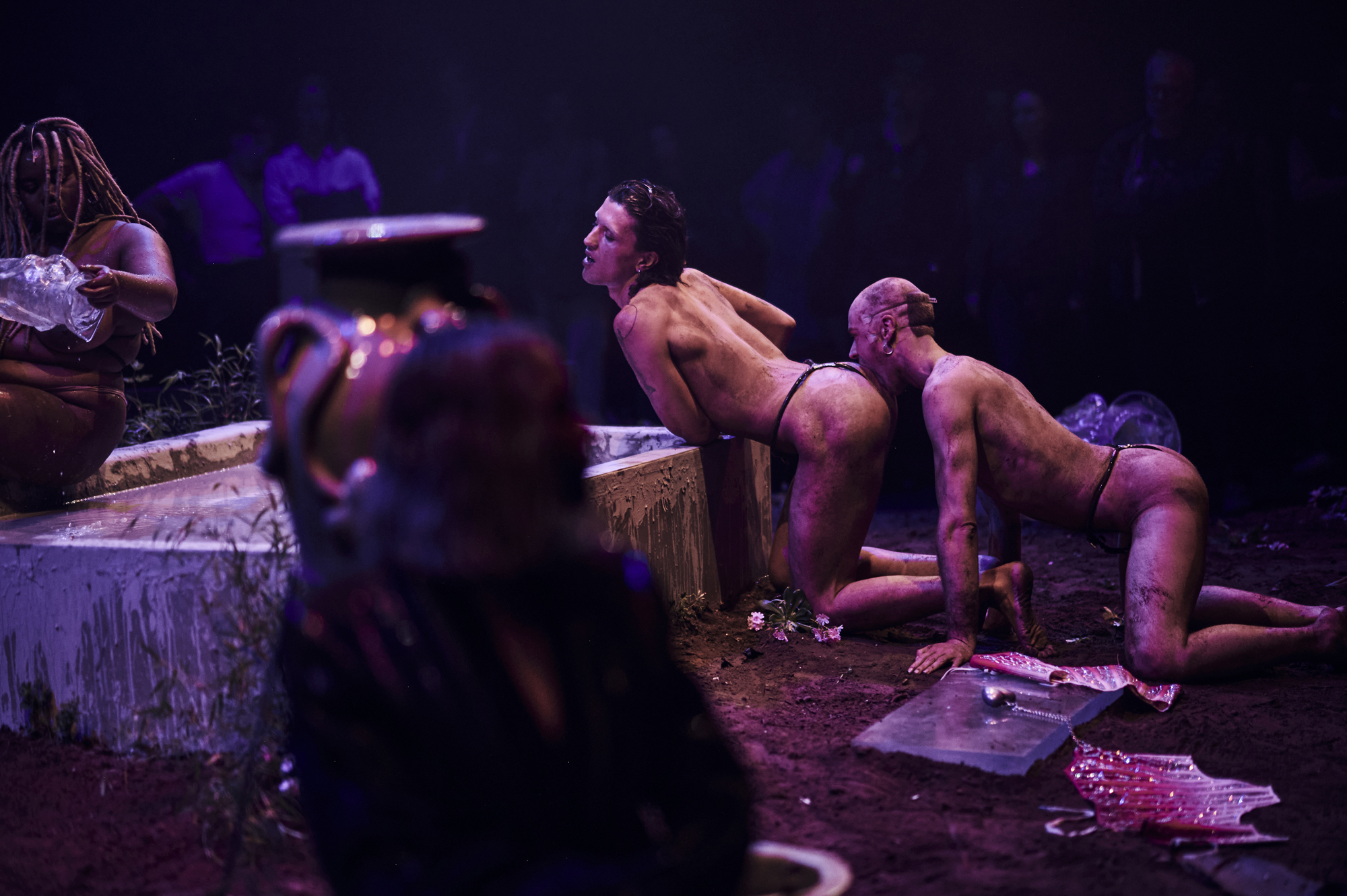
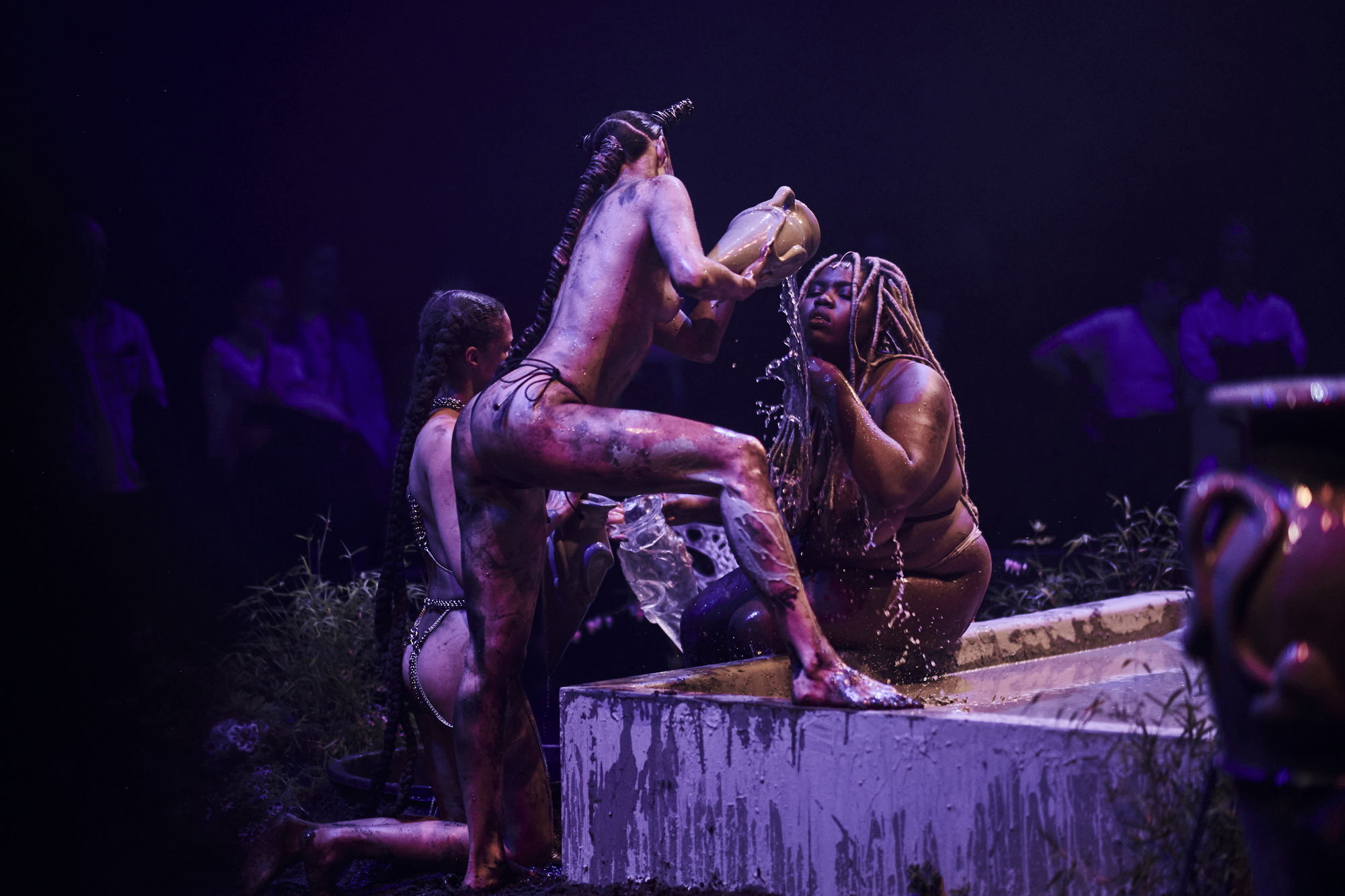
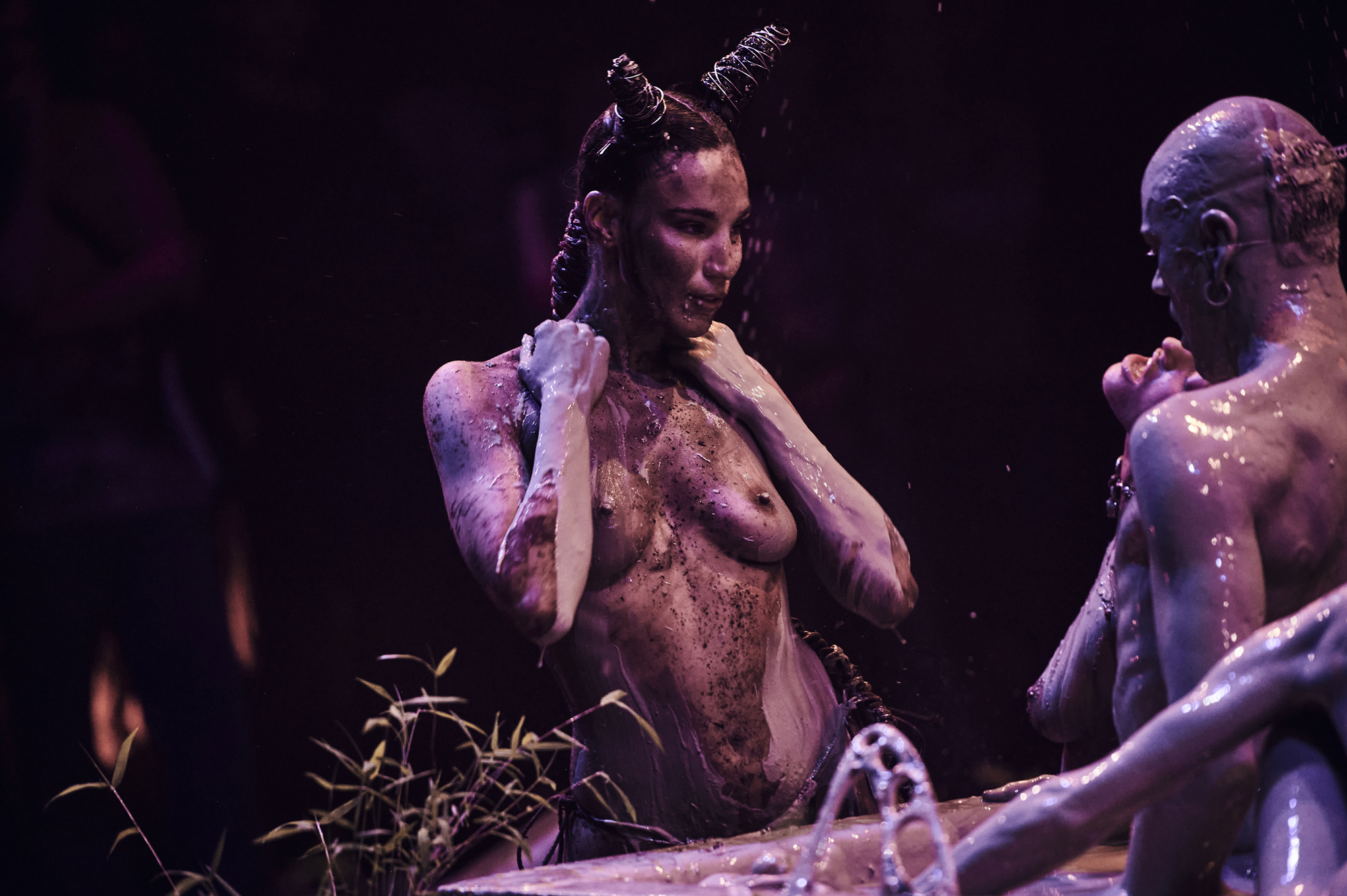
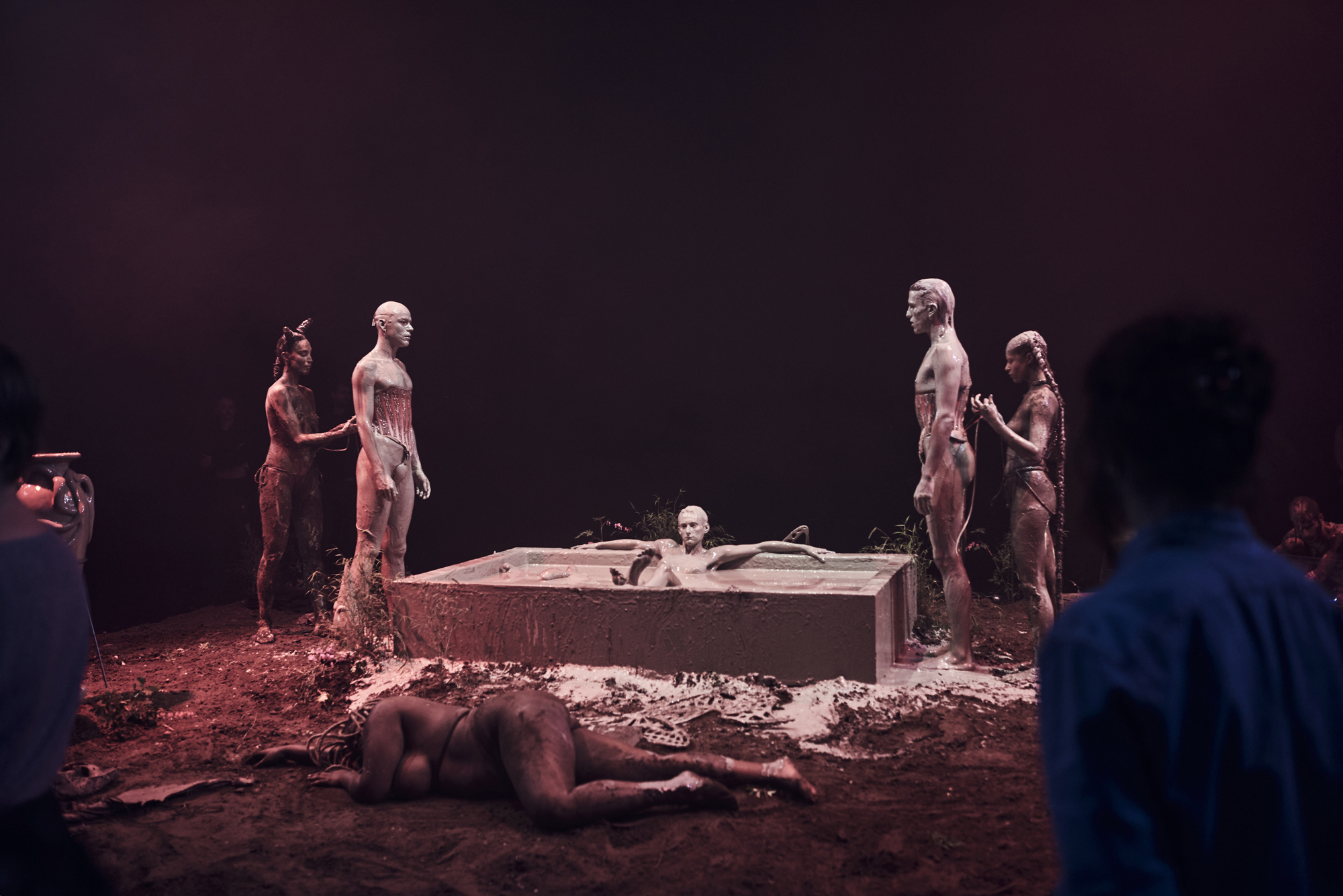
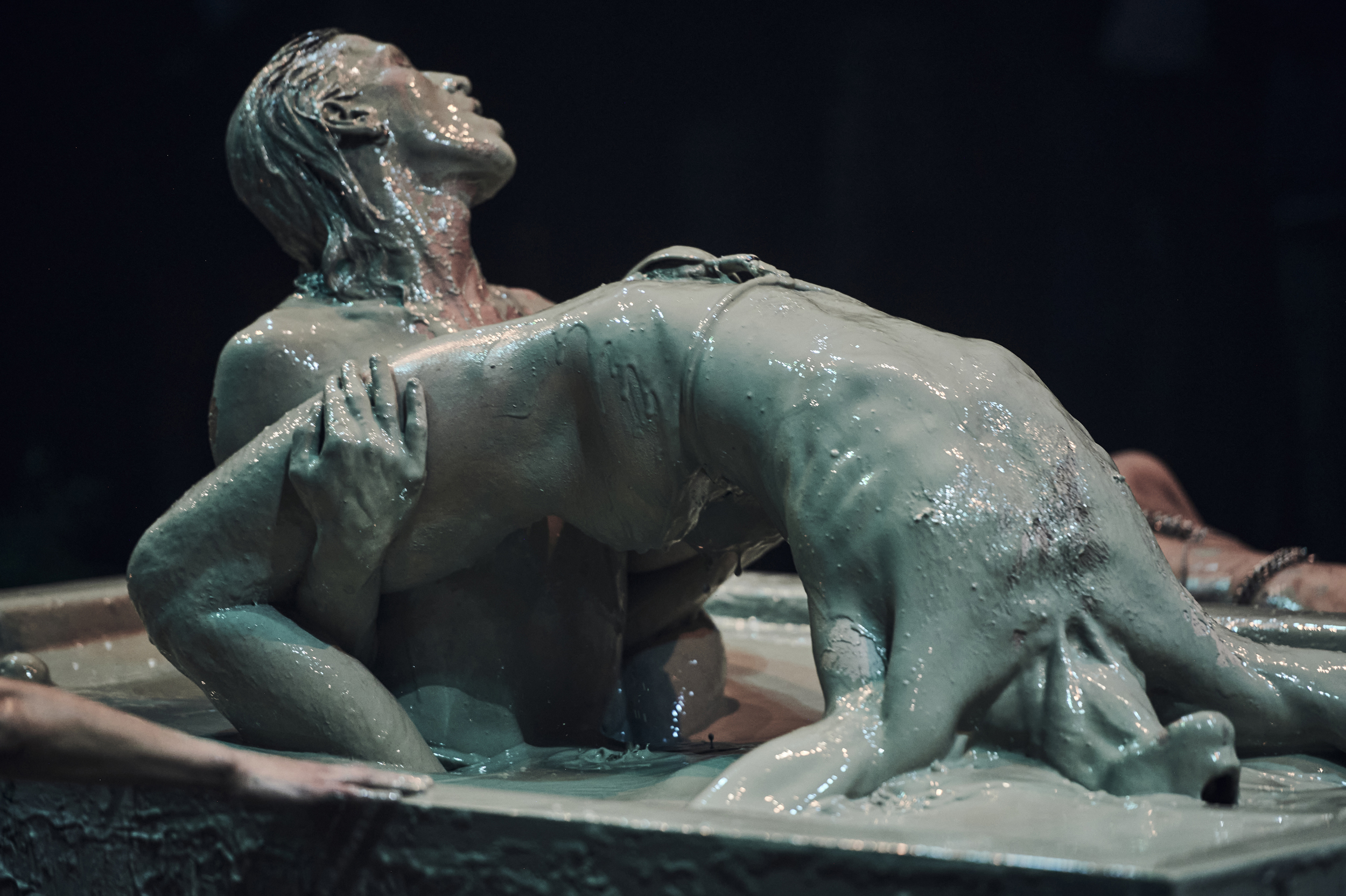
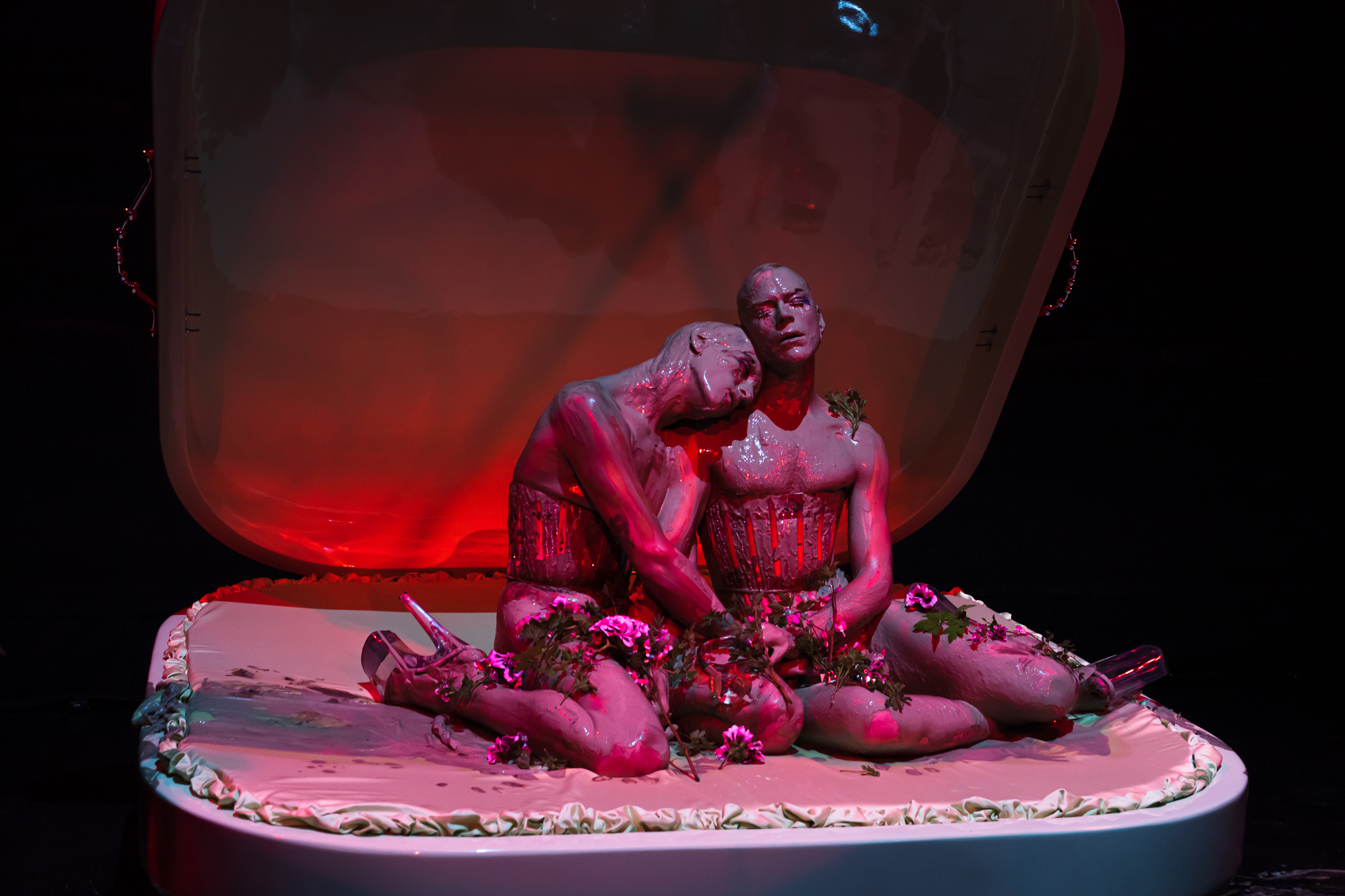
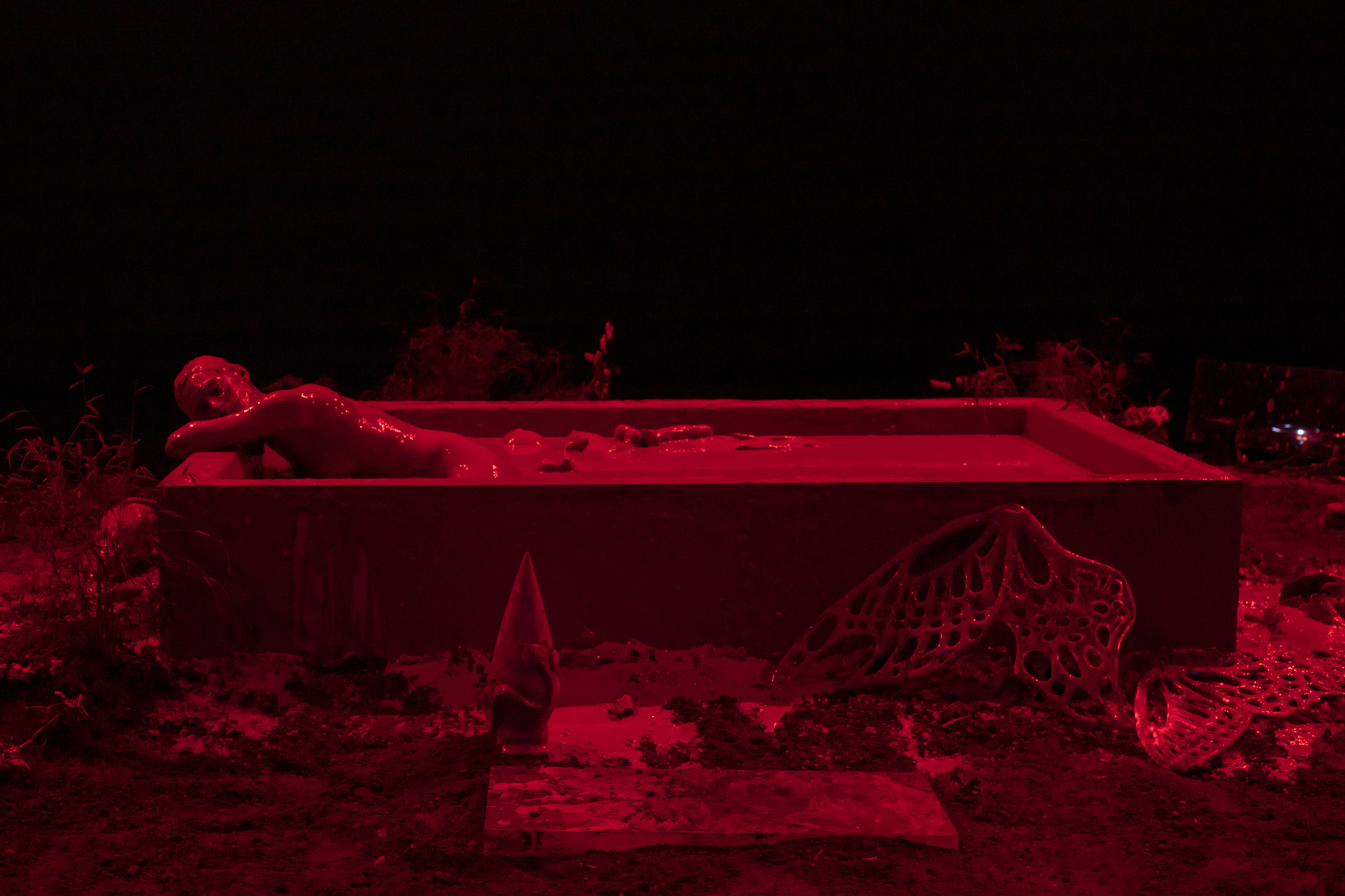
Let’s follow Van Looveren to a kind of altar made of a bed of earth, from which a triune Venus will later emerge from the mud bath. Flowers with blossoms grow around the whirlpool, which stands for opulence and perhaps also for an erotic playground. The Dicentra spectabilis are also popularly called bleeding or flaming hearts. Breathtakingly beautiful beings with long hair and fanciful robes animate this landscape. As if sprung from Hieronymus Bosch’s “Garden of Delights”, they play with incense and their bodies. Van Looveren and their performers (Oriana Mangala Ikomo, Julia Tröscher, Rachel Alvarez, Nicolas Maxim Endlicher, Inge Grognard and Sofie Velghe) work with role-playing methods and lend their bodies to their fictitious identities for the duration of the performance. In the immediate vicinity lies a lifeless, sexless and opulently decorated body made of silicone and wax, laid out on an operating table. Again it is a copy of van Looveren, this time life-size. Under a bright light, the sculpture lies surrounded by lifelike casts of human genitals in all colours of the rainbow. Early on, artists like Alina Szapocznikow (1926-73) dissected the human body with mixed feelings between agony and pleasure, sex and death, humour and self-deprecation. Van Looveren’s body-bags, which at first glance look like a joke by the fashion designer Demna Gvasalia, could also be seen as having complex origins in memory of the sculptor Anu Põder (1947-2013). The most direct reference to this possible history is the wax sculpture Imagining Monuments (2019): a blood-red wax cast of Van Looveren’s lower legs and feet, slowly melting away when fitted with a candle wick. The sculpture is a transformation that constantly changes shape, colour and consistency.
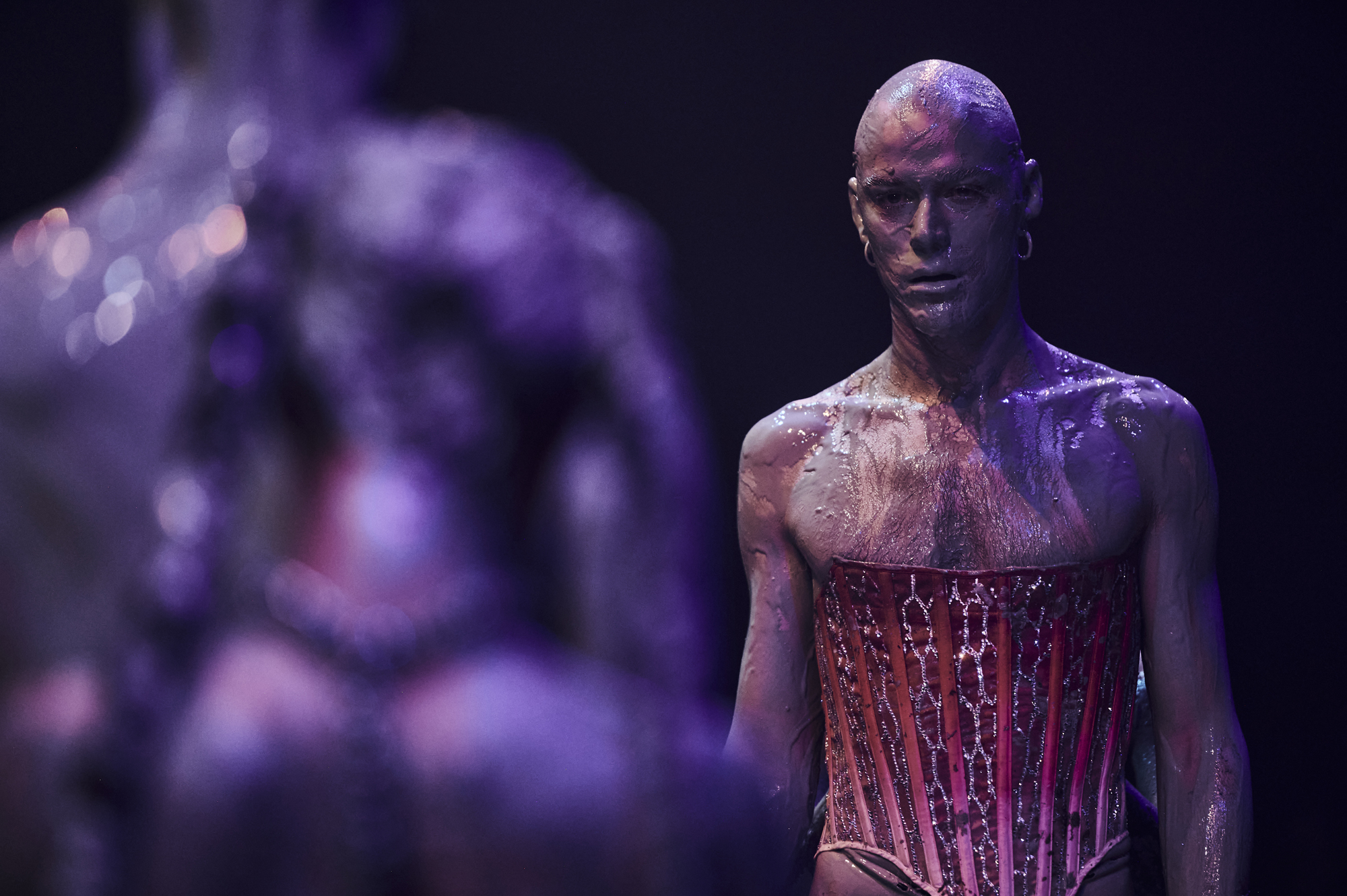
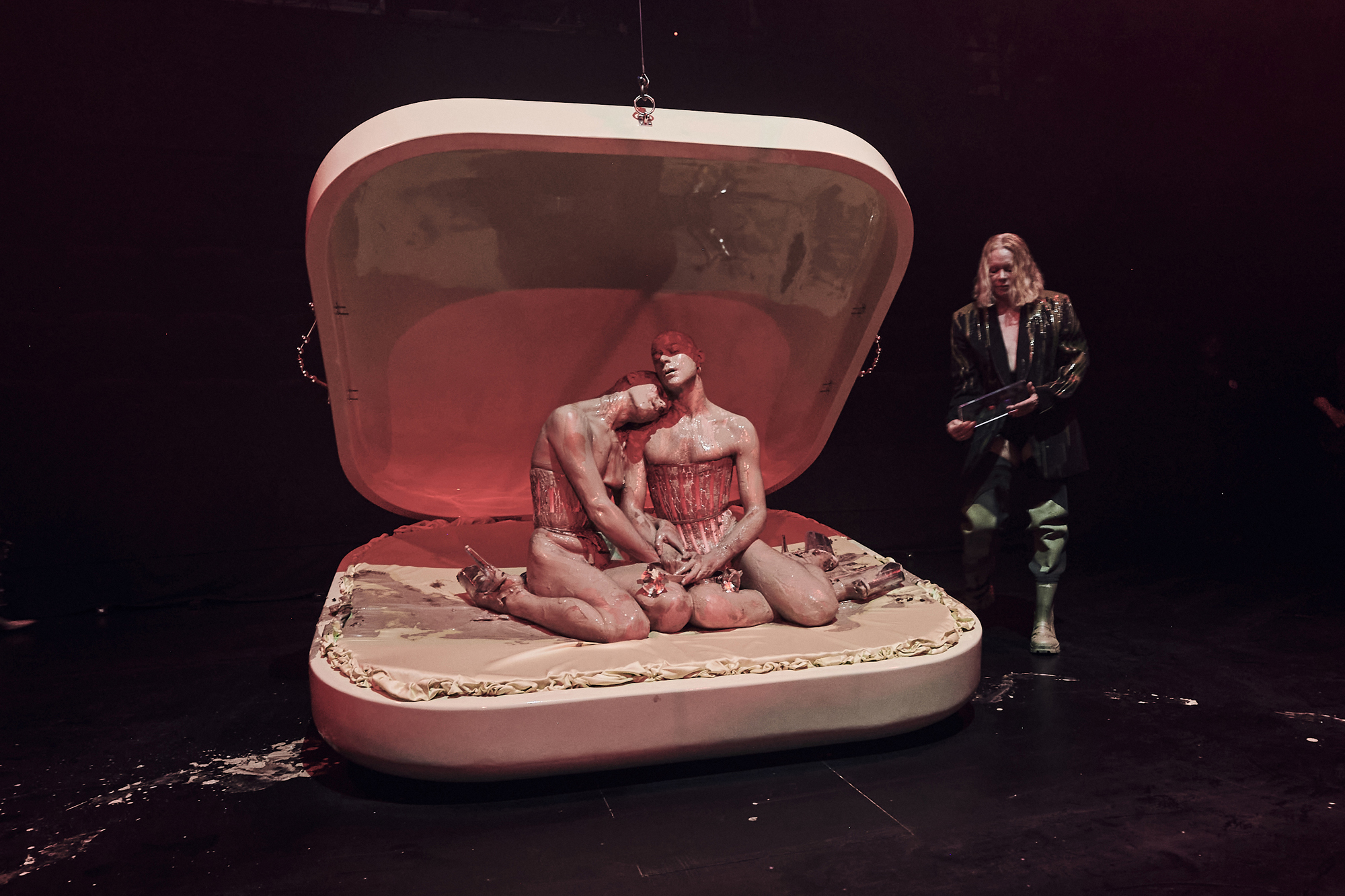
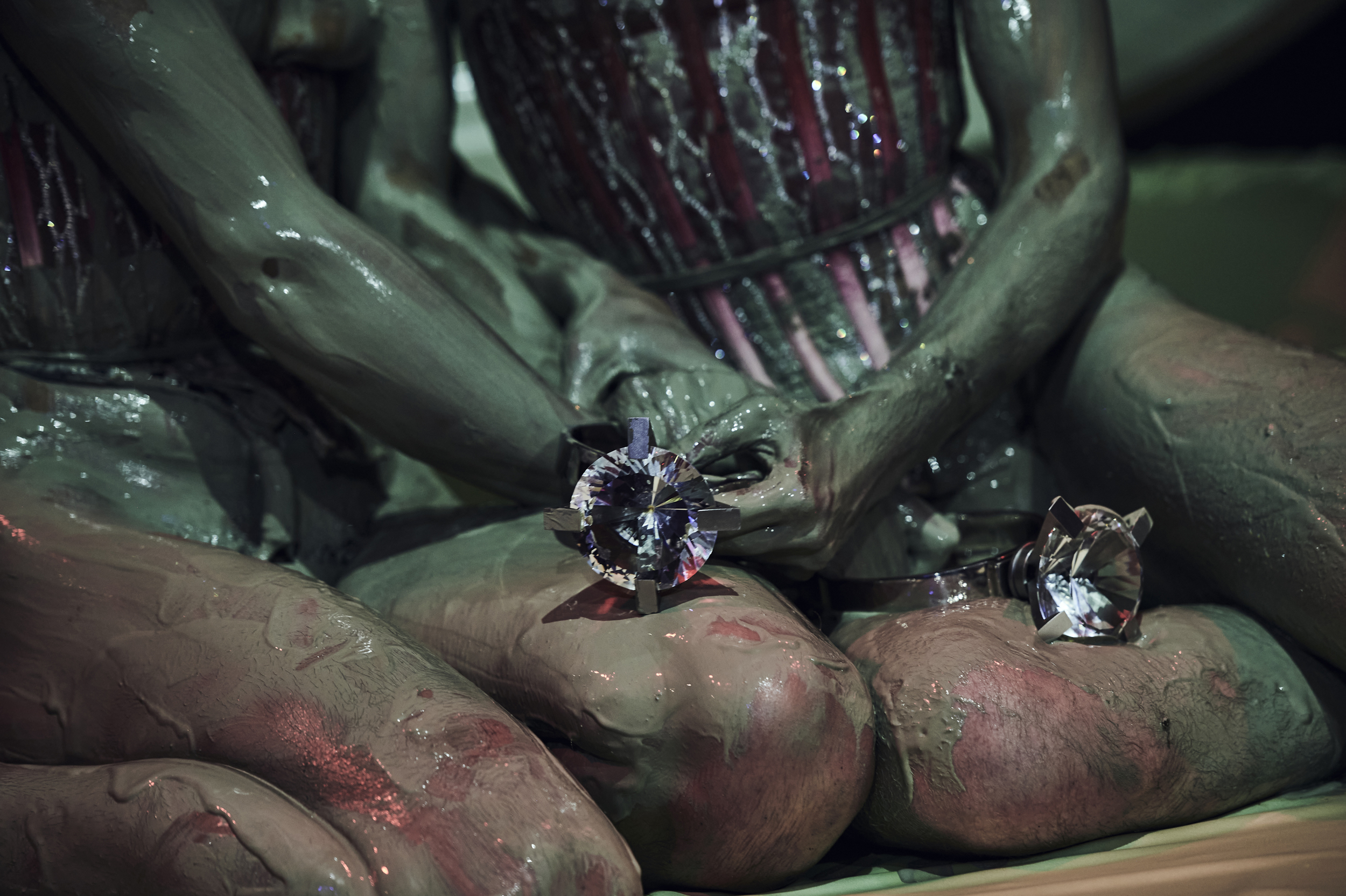
Van Looveren’s bodies seem completely absorbed in the play of their transformations, they do not show the quiet rage and despair of early feminist body experience. Corsages, flesh-coloured and glittering, recall the beaded silicone sculptures of Doreen Garner. The artist refers to the misconception that illness and disability are failures caused by the body of the individual. Through the corset, it becomes clear that they are a condition that is often also systemically and unjustly produced – whether by a normative health system, environmental pollution, racism or capitalism. A burlesque, passionate birth whose sobs combine uncannily with the danceable soundtrack that also uses ASMR and micro-noises to subconsciously evoke the so-called “tingles”, deep relaxation or excitement in the audience. In the course of the performance, dust, mud, sweat, spit and make-up cover the dancing bodies like a second skin, which become more and more ecstatic. With prosthetic sex toys, they join together in an uninhibited act of love to form a hydra whose countenance is reminiscent of Christian icons one moment and Shu Lea Cheang’s queer pornography the next. Like Cheang, Stef is aware that intimacy and sex are highly vulnerable to appropriation and control by commercialism. Cheang used the ambiguous status of her “eco cyberpornographic” art practice to question the potential utility of bodies (and art) in the digital age. Van Looveren was born in the year Orlan turned her body into an artwork and their work is a child of this digital age. Our bodies are the prism through which we experience our existence. We should take them seriously, but not too seriously.
SARAH JOHANNA THEURER is a curator specialising in time-based art practices and techno-social entanglements. She works at the Haus Der Kunst in Munich where she realises retrospectives as well as new productions, live events and symposia.
MALENE HAGEN studies art history and philosophy at the Ludwig-Maximilans- Universität in Munich. Her research focuses on fluid media practices of post-digital art and their forms of perception in the context of (neuro-)aesthetics.


Can love be political?
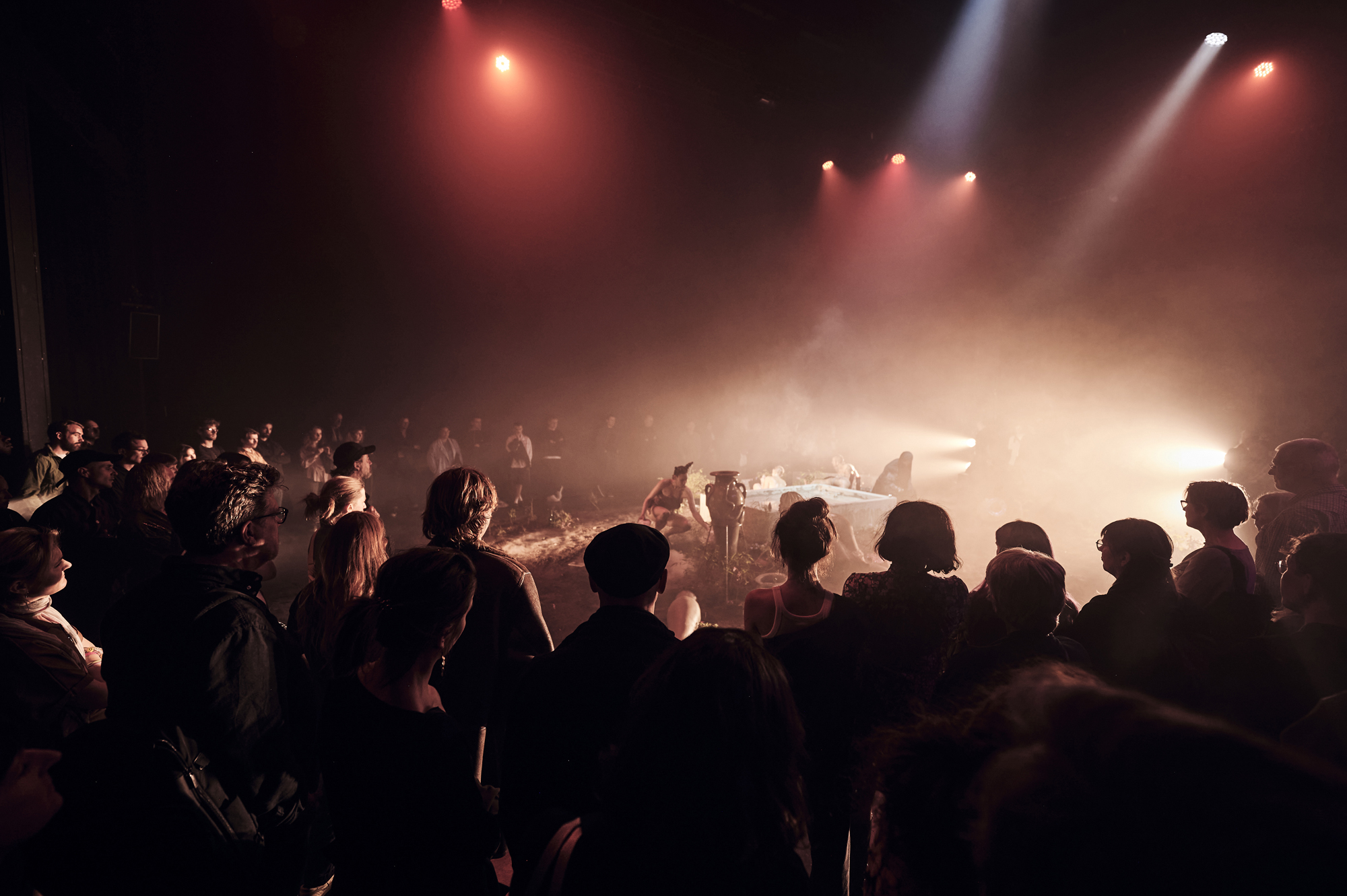
It’s a question that continues to resonate long after Radical hope – eye to eye. This first live performance by non-binary visual artist Stef Van Looveren (1992) sits somewhere between a fashion happening, occult ritual, film installation, and living exhibition. So don’t expect a traditional performance, but rather a series of mysterious tableaux that layer queer eroticism with transhuman imagery, all set to a soundtrack of minimal techno.
Van Looveren brings together a number of existing sculptural works in a new constellation. Among them is a reworking of Between the devil and the deep blue sea (2020), an avatar-blue, genderless silicone figure richly adorned with diamonds. Surrounding it are Van Looveren’s famous DPA/DIP (dick, intersex, pussy, ass) handbags. On a large screen, we see a fragment of an intimate choreography, where each performer embodies a different gender. In one sweeping motion, the piece dismantles fatphobia, Islamophobia, and transphobia.
Van Looveren’s resistance to gender norms feels both assertive and effortless. They present a world in which bodies are no longer reduced to gender, but are free to choose their own fluid identity.
Also remarkable is the way the artist brings eroticism out of the private sphere and into the public heart of the theatre. This powerful gesture of emancipation leaves no one unmoved. The jury is not only impressed by Van Looveren’s boundary-pushing aesthetics, but also by their strong presence as a performer. Rarely have we witnessed such radically utopian inclusivity on stage. We are curious to see what else Van Looveren has in store for the performing arts. – Het Theaterfestival
Concept, performance: Stef Van Looveren
By and with
Performers:
Rachel Alvarez, Oriana Mangala Ikomo, Julia Tröscher, Charlotte De Waegenaere, Mustaf Ahmeti, Nicolas Maxim Endlicher, Inge Grognard, Sofie Velghe, Stef Van Looveren
Sound: Nicolas Maxim Endlicher a.k.a. MCMLXXXV & Cem Dukkha
Light technician: Anne Meeussen
Live Make-up: Inge Grognard
Video performers: Karina Zharmu, Shaïne Mahaux, Oriana Mangala Ikomo, Absa Sissoko, Tommy Vanstippen, Judith Willems, Marie Willems, Nathan De Laet, Emmuran Murengo, Nathalie Nijs, Florence Carlier, Rachel Alvarez, Marion Marguerite Denné, INTI, Deveny Faruque, Chaima El Haddaoui, Krenare Zeka, Julia Tröscher, Hannah Mateus, Nixie Velocity Blaze, Eddy Louisia, Bobby Louisia Velocity Blaze, Fleur Van De Merlen, Marc Van Looveren, Emilija Dūdaitė, Kaidan K, Charlotte De Smedt, Rindy
Make-up artist video: Maria Ovejero
Many thanks to: Julia Tröscher, Emilija Dūdaitė, Anthe Hermans,
Philipp Kern, Deborah Bloemen, Marloes Dadswell
Commission & co-production: DE SINGEL
With the support of: Stad Antwerpen & de Vlaamse overheid
Video footage shot by Beeldstorm
Images by Nathan Ishar and Anna Carina Schoeters
Soundtrack used for the video by Cem Dukkha